Which 3D printing material to choose: PLA, PETG, ABS, resin
PLA, PETG, ABS, TPU, ASA or resin: properties, uses and resistance to the Canary sun. A guide to which 3D printing material to choose in Tenerife.
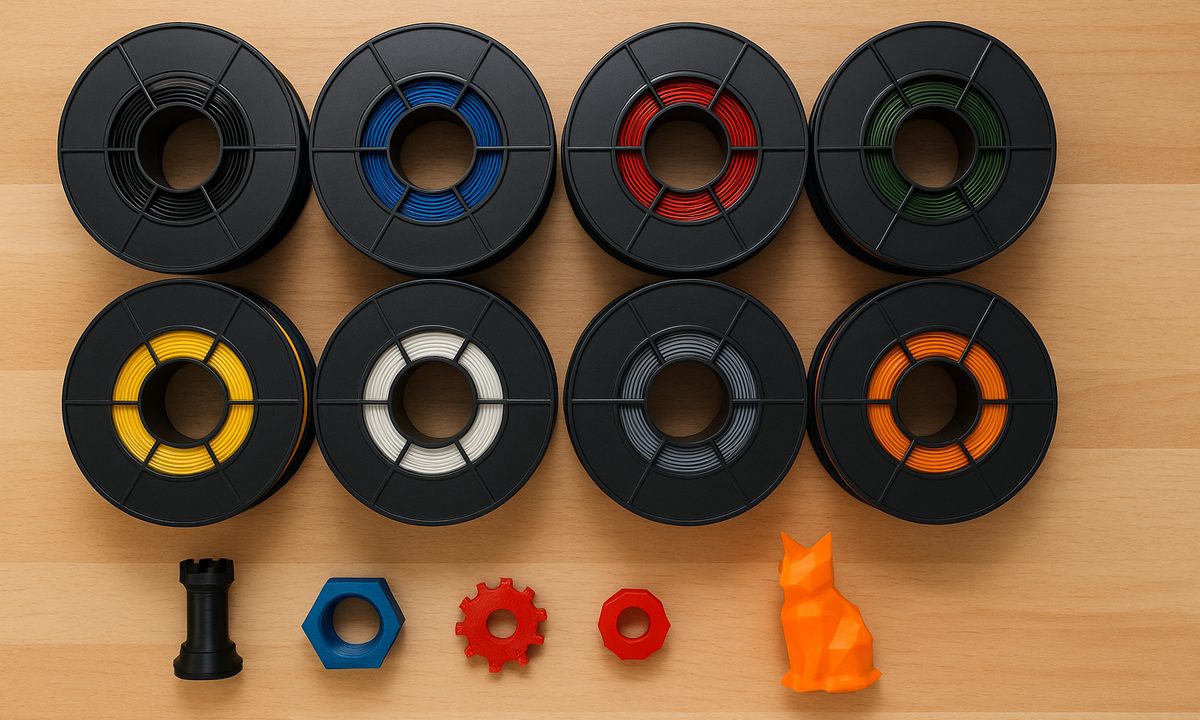
Your design is ready, but a very fair doubt holds you back: which 3D printing material should you choose? PLA, PETG, ABS, TPU, ASA and resin are not interchangeable — each one shines in one use and fails in another. And in the Canary Islands there is a factor almost nobody mentions: the sun. Let us clear it up without jargon.
FDM or resin: two ways to print
We work with two technologies. FDM melts a filament layer by layer: this is the family of PLA, PETG, ABS, TPU and ASA, ideal for functional, strong or large parts. Resin starts from a liquid cured with light and gives the highest level of detail, perfect for miniatures and fine finishes. We print pieces up to 30×30×30 cm in a single go; anything bigger we make in sections, with joining and a professional finish.
Materials table: properties, uses and sun
| Material | What it is like | What it is for | Sun and outdoors in the Canaries |
|---|---|---|---|
| PLA | Rigid, easy and economical | Decoration, figures, prototypes, models | Indoors only: the heat of the sun warps it |
| PETG | Strong, slightly flexible, tolerates heat and humidity | Functional parts, kitchen, moderate outdoor use | Handles moderate outdoors, better than PLA |
| ABS | Hard, resistant to impact and temperature | Mechanics, car parts, housings | Works, but UV yellows it: for sun, use ASA |
| TPU | Flexible and elastic, like rubber | Gaskets, cases, bumpers, parts that bend | Chosen for flexibility, not for the sun |
| ASA | Like ABS, but formulated for the outdoors | Outdoors, signs, first coastal line | The king of the sun: no yellowing under UV |
| Resin | Maximum detail and a very smooth surface | Miniatures, jewellery, dental, fine prototypes | Better indoors; not an outdoor material |
Which material resists the Canary sun
Here is the key that makes the difference on the Islands. PLA warps with the heat of a car or a shop window in the sun, so it is ruled out for outdoors. Common ABS and PLA yellow and turn brittle under UV radiation. ASA is formulated for exactly this: it takes the sun without fading and resists salt air, which is why it is our standard for signs and outdoor parts, especially on the first coastal line. PETG covers moderate outdoor use well, in the shade or under mild sun. If your part lives outside, the sun-resistant material in the Canary Islands is ASA.
How to choose based on your part
To get it right, think about where and how the part will work:
- Decoration or an indoor gift → PLA: attractive, cheap and enough.
- Functional, kitchen or mild outdoor part → PETG: resists heat, humidity and impacts.
- Mechanics, car or technical housings → ABS: hardness and thermal resistance.
- Something that bends, cushions or seals → TPU: flexible like rubber.
- Sign, façade or first coastal line → ASA: sun and salt without yellowing.
- Miniature, jewel or fine detail → resin: maximum definition.
We accept STL, STEP, 3MF and OBJ files; if you have no file, we model it from a photo, sketch or description (3D design from 20–60 €). As a guide, a small part costs from 5–15 €, a medium one 15–40 € and a large or technical one 40–120 €.
We tell you the ideal material within 24 h
Tell us what part you need and where it will be, and we will recommend the exact material with a fixed quote within 24 h, IGIC invoice included. Write to us through the contact page or WhatsApp. You will find all the details on the 3D printing service and on our 3D printing materials page.
Frequently asked questions
What is the difference between PLA, PETG and ABS?
PLA is rigid and economical, ideal for interiors, decoration and prototypes, but heat warps it. PETG resists heat and humidity better and suits functional parts, kitchens and moderate outdoor use. ABS takes more impact and temperature, meant for mechanical parts and car components; for direct sun, ASA is the choice.
Which material resists the sun in the Canary Islands?
ASA: it is formulated for the outdoors, withstands UV radiation without yellowing or turning brittle, and resists coastal salt air. It is what we use for signs, outdoor parts and the first coastal line. PETG copes with moderate outdoor use; PLA in full sun does not.
When is resin better than FDM?
When you want maximum detail and a very smooth surface: miniatures, jewellery, fine prototypes or dental parts. For large, functional or outdoor parts, FDM with PLA, PETG, ABS or ASA is better.